Pianos are heavy, awkward and easy to damage, so most people use professional movers. A team measures the route, protects the instrument, straps it to a trolley and handles stairs with extra care. This guide explains how pianos are moved, what varies by type and what to do afterwards.
A piano is one of the few things in a house that almost everyone agrees you should not move yourself. It is heavy, it is awkward, and it is often worth more than its price tag suggests, in money or in memories. It also has a frame and strings that do not forgive being dropped, tilted or knocked.
We move households across Southampton and Hampshire, and pianos come up regularly, usually with a nervous owner and a narrow hallway. This guide explains how to move a piano, what removal teams actually do, what varies by type of piano and what to do afterwards. It is general information. Tell us about your piano when you ask for a quote, because we need to know the type, the location and the route before we can say what is possible.
Can you move a piano yourself?
You can, but in most cases you should not. The risks are simple to describe. A piano is heavy and top-heavy, so it can tip. Its weight is not evenly spread, which makes carrying it awkward. Its casing, legs and pedals are easy to damage, and its inside is delicate. And stairs, doorways and tight corners multiply every one of those problems.
The person most likely to be hurt is you, followed by the piano, followed by your floors and walls. That is why we would strongly suggest a professional team for anything other than a small, lightweight instrument, and even then with more than one pair of hands. We have not quoted weights, because they vary widely, and the manufacturer or a piano technician can tell you about your instrument.
Types of piano and how they differ
Not all pianos are moved in the same way. The main types are these.
- Upright pianos. The most common type in homes. They stand against a wall, are tall and heavy and are usually moved upright on a trolley, strapped and padded.
- Grand pianos. Larger and more complex. They usually need to be taken apart in stages, with the legs and pedals removed and the body tilted onto a special board, which is a specialist job.
- Digital pianos. Lighter, but still bulky, with delicate electronics. They are usually easier to move, though they still need protecting from knocks and dust, and the stand and pedals may come apart.
- Keyboards and small electric pianos. Easy to move by comparison, but worth padding and packing carefully.
If you have a high-value, antique or unusual instrument, tell us early. It may be worth asking a specialist piano mover, or your insurer, whether special arrangements are needed. Ask us about your piano when you get your quote, so we can tell you honestly what we can do.
How a removal team moves a piano
The details vary, but the process for a professional team looks like this.
- Survey the route. The team looks at the piano, the doors, the hallway, the stairs, the corners and the vehicle access, and measures anything tight.
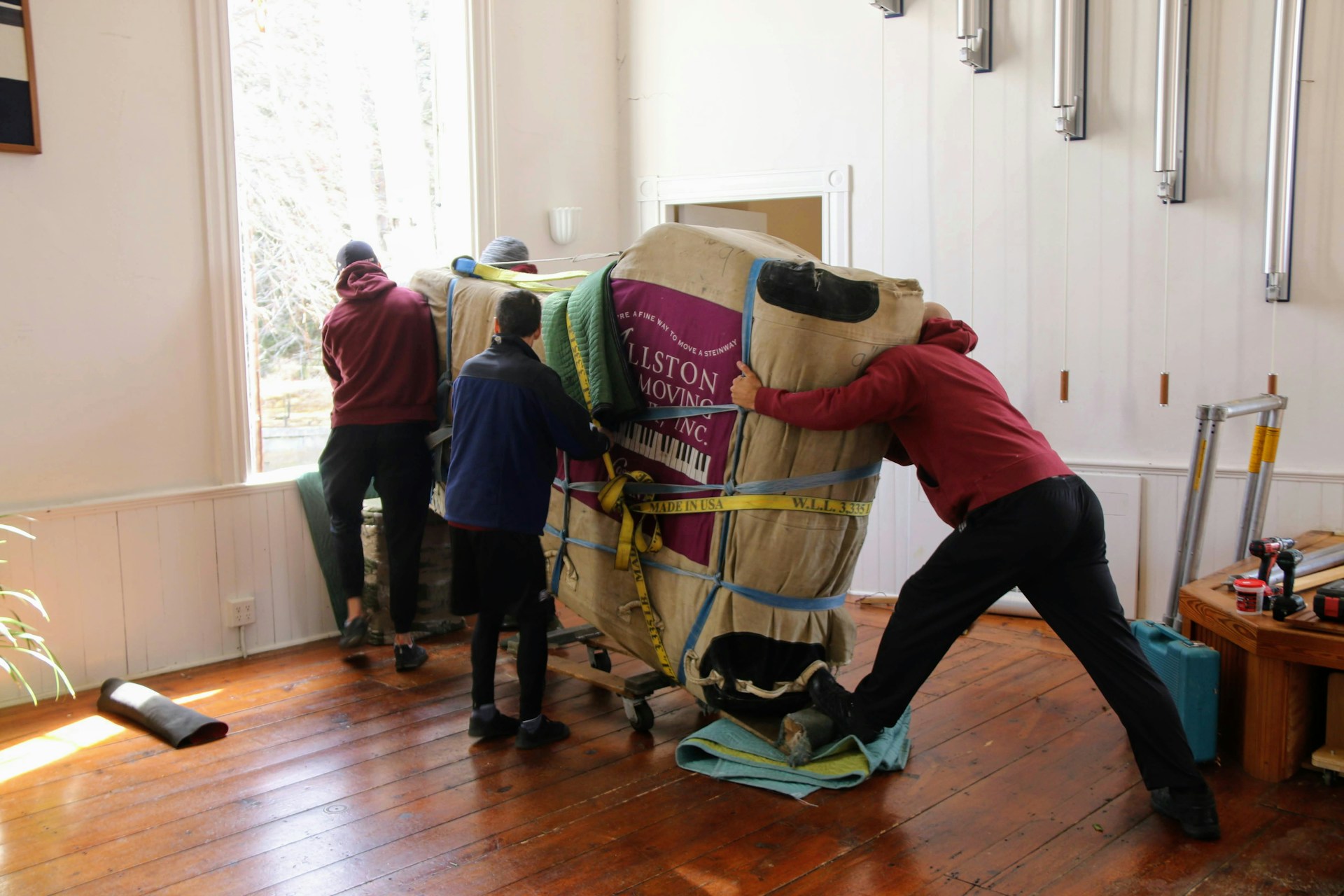
- Prepare the piano. The lid and keyboard cover are secured, and the piano is wrapped in padded covers to protect the finish.
- Fit the straps and trolley. The piano is secured to a trolley or board with straps, so it can be moved without carrying its full weight by hand.
- Move it carefully, with enough people. The team works together, and communicates at every step and corner.
- Load and secure it. The piano is loaded into the vehicle upright or as its type requires, strapped to the vehicle and protected against movement.
- Unload and place it. It is brought into the new home along a route checked in advance, and placed where you want it.
We would rather look at the route in advance than find a problem on the day. Photos of the piano, the doorways and the stairs help a lot when you ask for a quote.
Stairs, narrow doors and tight corners
Stairs are the hardest part of most piano moves. A piano going up a flight in a Southampton terrace, with a turn at the top and a low ceiling, is a job that needs planning, not optimism. A team will measure the width of the stairs, the height of the ceiling, the angle of the turn and the distance to the room.
Sometimes a route is simply not possible. If a piano will not physically fit round a corner or through a door, the options are limited, and a professional team will tell you so before starting, not halfway up the stairs. That is another reason to survey first, and to tell us about the property at both ends.
After the move: settling and tuning
A piano can drift out of tune after a move, and the change in temperature and humidity in a new home can affect it as well. Most tuners advise leaving the piano to settle before it is tuned, and we have not quoted a fixed waiting time because it depends on the instrument and the home. Ask your piano tuner when they recommend booking, and arrange it in advance.
Place the piano away from radiators, direct sunlight and damp walls if you can, because those can affect the instrument. If you notice anything unusual after the move, such as a sticking key or damage to the finish, tell us and your tuner promptly.
Preparing your home and paperwork
- Clear the route. Move furniture, rugs and ornaments out of the way, and check the floor for anything that could be scratched.
- Measure the doors and corners at both ends, and tell us about any stairs, steps or tight turns.
- Take photos of the piano and the route, and send them with your quote request.
- Tell us the type of piano, the make if you know it and whether it is valuable.
- Check your insurance. Ask your insurer whether a valuable or antique piano needs specific cover, and ask us how our cover applies.
Summary
- Pianos are heavy and easy to damage.
- Professionals measure the route and protect the instrument.
- Stairs and narrow doors need a survey first.
- Arrange a tuning after the piano settles.
FAQs
You can, but we would not advise it for most pianos. They are heavy, awkward and easy to damage, and the risk of injury is real. A professional team with the right equipment is safer for you and the instrument.
A professional team measures the route first, then secures the piano to a trolley or board with straps and moves it step by step with enough people. It is not a job to improvise, and some routes are not possible at all.
It often needs tuning, because the move and the change of environment can affect it. Most tuners advise letting the piano settle first. Ask your tuner when they recommend booking.
Usually, yes, and they are lighter than acoustic pianos, but they still need care. Tell us the type when you ask for a quote, and we will confirm what we can do.
Every move we carry out is fully insured, but a valuable or antique piano may need specific cover. Ask us how our cover applies, and ask your own insurer about your instrument.
One Last Thought
Need a piano moved in Southampton or Hampshire? Call K2 Swift Removals on 023 8111 3116 or 07356 097791, tell us about the piano and the route, and we will give you a straight, free quote.